
Interview: grace (ge) gilbert, Author of Holly
“For most of my childhood I made a habit of looking for answers on my own,” says the speaker in Holly [YesYes Books 2026], the debut poetry collection from writer and artist grace (ge) gilbert. This book is a descent into the archive, both personal and material, surrounding the 1976 murder of gilbert’s grandmother, Holly. Holly expertly balances docupoetics and the confessional, creating an embodied exploration of some of life’s most difficult questions through language and image. Each poem is composed of cut paper fragments scanned onto the page, immersing the reader in the sense of rifling through documents, or thumbing through old newspapers. Collages rendered from old family photographs, articles covering the murder, and other ephemera, appear throughout the collection. Click here to see excerpts from Holly.
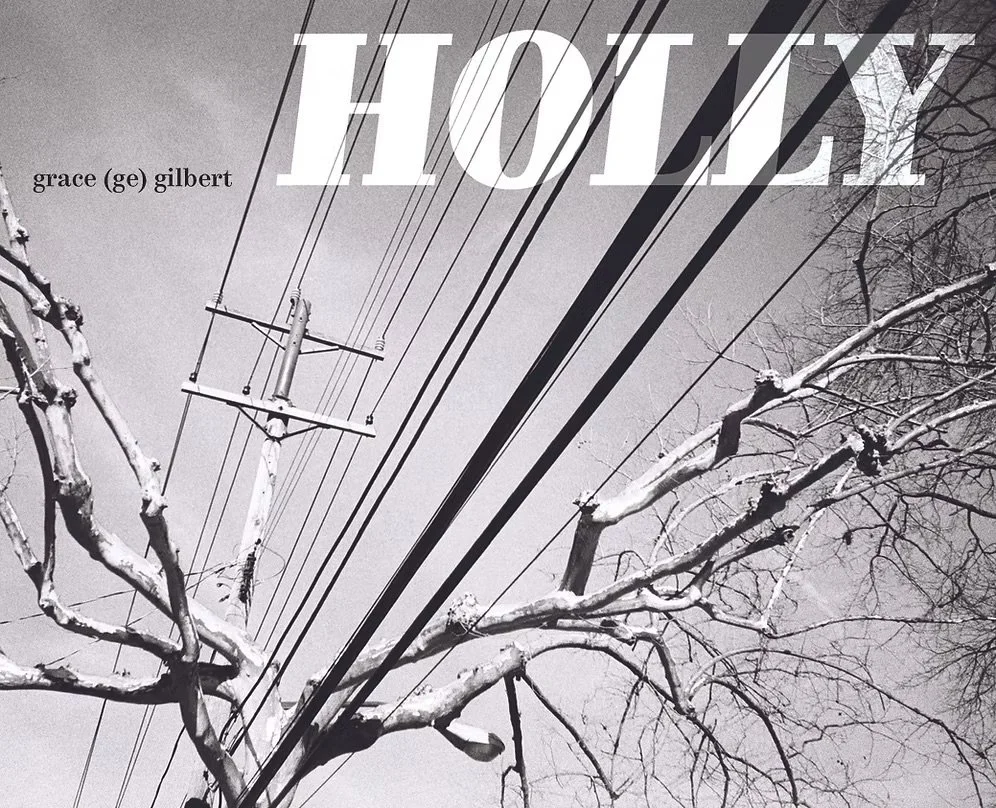
Photo courtesy of YesYes Books.
Gilbert refuses simple conclusions and emotional resolutions, instead inviting the reader into a place of questioning and discovery. Their work is haunted by the unknowable, which we see in the poem “Holly As Survey of Questions for the Survived” (inspired by CD Wright’s “Breathtaken”), where the poet subverts the typical lines of questioning following a death: “Was the deceased fully clothed when found?... Did the deceased think of how her children needed haircuts?” Throughout this investigation, Gilbert delicately guides the reader’s eye, never allowing us to ogle the tragedy at the heart of this collection, but still revealing to us the difficult landscape of a family shaped by a violent crime.
Holly’s poems are constructed of images of words on scraps of paper. There is a sense that these scraps have existed elsewhere, and were carefully rifled through, selected, and pasted on the page for the reader to discover. How do you understand the role of investigation, research, and discovery as it pertains to your work?
In Solmaz Sharif’s essay “The Near Transitive Properties of the Political and Poetical: Erasure”, she lists a survey of political and aesthetical objectives that contemporary erasure often attempts to accomplish. The one I think about most often is number two– that erasure exists “to collapse time and instance between dead and living (e.g. ‘The dead do not cease in the grave’ –Srikanth Reddy, Voyager).” There is an inherent culpability and violence in the act of redaction, which is an act of choosing, of preserving or destroying, and sometimes all of the above. In my role as the curator of this archive, I had to wrestle with the violence of my own hand, of my own looking. There is a delicate tension that lives on the edges of these scraps, the torn pages, the obscured images– there is the desire to take everything I can get, and the desire to rend carefully my process of this discovery. What became important to me early on was to lean into the power I have in this story, and not to necessarily try to refute it or compensate for it. While we often plumb archives for answers, and I think originally I thought this was what I was doing, it’s the reaching, the grappling, the dynamics of power and the disappointment of the living’s interactions with the dead that interest me most. I began this project with the idea that I might uncover something, but instead of doing that, I illustrated an attempt. I think it’s important to hold fast and loose the promise of the archive, and to engage with it in ways that show our culpability and our hand.
As a visual artist and poet, how do you see these two mediums interacting? Did you always know that collage would be a part of this project?
I had no idea what I was going to end up with at first. I initially approached the book from a narrative nonfiction angle. I thought I would be conducting interviews, traveling to document familial history, mining prison records, and looking through case files. In my first few drafts, however, I was forced to confront the feeling of flatness that the work was giving me. I couldn’t write around the fact that there were unnoticeable dimensions in the narrative that were not coming through, especially given that absence and silence are main characters in this story. Early in my drafting, I learned that I am more interested in what scholar Tina Campt calls the “haptic,” or the “felt” frequencies of archival material than the typical understanding of text and image as description and illustration. I sort of learned this by accident. At one point, I started experimenting with what I had around me– engaging in what Saidiya Hartman calls “critical fabulation,” trying to reach across the plane of story and meaning rather than naming the facts. I had a strange assortment of found images, scans, and articles that didn’t cohere, because the narrative does not cohere or resolve. I found that there were voices and textures present in these visual experiments that did not need explanation, just space. And so the book “found its form” out of necessity.
In your poem, “Holly As Someday Daddy Will Tell You,” the speaker asks their mother a cascade of childlike questions. However, as the speaker begins to ask about their grandmother, the text itself begins to fade away, forcing the reader to have to lean in close to decipher what is being said. This speaks to the book’s overall interest in ephemerality and legibility, the sayable and the unsayable, what we remember and what we don’t, and as you say in one line, the truths we keep. How were you thinking about the process of creating a container for the fleeting and illusory?
I often think of text as a place where we put things so they survive. In my process of creating this project, though, I needed space for the jagged edges of absence, silence, and the unknown. It was and is important to me that imperfections and textures of discovery are present, not ironed out completely– there are places where the paper is pockmarked, the text a bit askew, things mildly blurred or illegible. The leaning in is a gesture that reflects the narrator’s process of discovery– eavesdropping, sifting through documents and materials, never quite coming to the complete picture. Mourning that incompleteness and also living in it. I wanted to design this book in such a way that you need to be close to it, you need to want to figure things out. And there is the frustration in not getting that, but there is also the intimacy of looking, knowing. And that is always what I’ve found more interesting than cold-hard fact.
We are living in what feels like the heyday of true crime podcasts, shows, and documentaries. Violence has become an easily consumable (and profitable) spectacle. However, Holly refuses voyeurism, diluting the thrill of shock by telling us on the first page the circumstances of Holly’s death. Even in its most personal, confessional moments, there’s a measured distance to the speaker’s voice that allows the reader to always have a wide angle shot of both the tragedy itself, and the way that it has trickled down through generations of your family. Were there other works that provided guidance for you in writing about violence? How were you thinking of navigating spectacle versus investigation as you were writing?
In my second book that I’ve been working on for the last four years or so, I am thinking a lot about the questions that Holly raised in me. One short poem in the series reads, “The marker bleeds through the page. But this bleeding is not red. It’s when you can see through the present to the past.” I’m thinking about absorbency, blood, stain, violence as the ephemera of womanness. I resist the “true crime” genre mostly because of the issue of the spectacle. In writing Holly, I had to think a lot about the murdered white woman as symbol, as warning, as harbinger of oppression for marginalized groups of people. The same whiteness that provides power to the victim in life harms them in death; they lose their personhood and become a placeholder for some other public feeling. Folktales mostly deal with women. We make stories of them. I make stories of my grandmother. The distinction was and is difficult to parse. Instead of finding that line, I think about the blood and the bleeding. The way the sheets of time between us are stained with her blood, the way I stain back, the edges and the seeping. This is the long project, to sit with violence and its emptiness, not to heed warning or sensation. To sit with. To look. To feel shame and grief in that looking.
Finally, I am thinking of Muriel Rukeyser saying that poetry can extend the document. As you worked with newspaper clippings, found family photographs, and memory, how did you come to understand the relationship, and even need, for poetry to exist alongside the archive?
I’m thinking of the Derrida quote, which I first encountered in Julietta Singh’s book No Archive Will Restore You– “...nothing is less reliable, nothing is less clear today than the word ‘archive.’” The ‘archive’ at its core is illusive and ephemeral, pinned beneath the buttoned-up promises of academia. The problem is that the archive is not capital, it is what’s left. When someone leaves, what they leave is an archive. In thinking this way, I did not approach the archive as a place of answers. Well, maybe at first I did. But it became clear rather quickly that this book operated in the realm of the poetic because it relied on juxtaposition– textures of loss pushed up near each other to create meaning. If logic can’t create meaning, proximity and circumstance can, which is the sort of fabulation I was working with in the collages. To me, this is the register of the poem: a wild reaching, an honest guess. I had little pieces. I put them together. The form was what my archive necessitated. I think this grappling, this honesty, is a way to enter the archive in a more radical way than what we are taught to do institutionally. It requires the self as a necessary function and material of the archive.
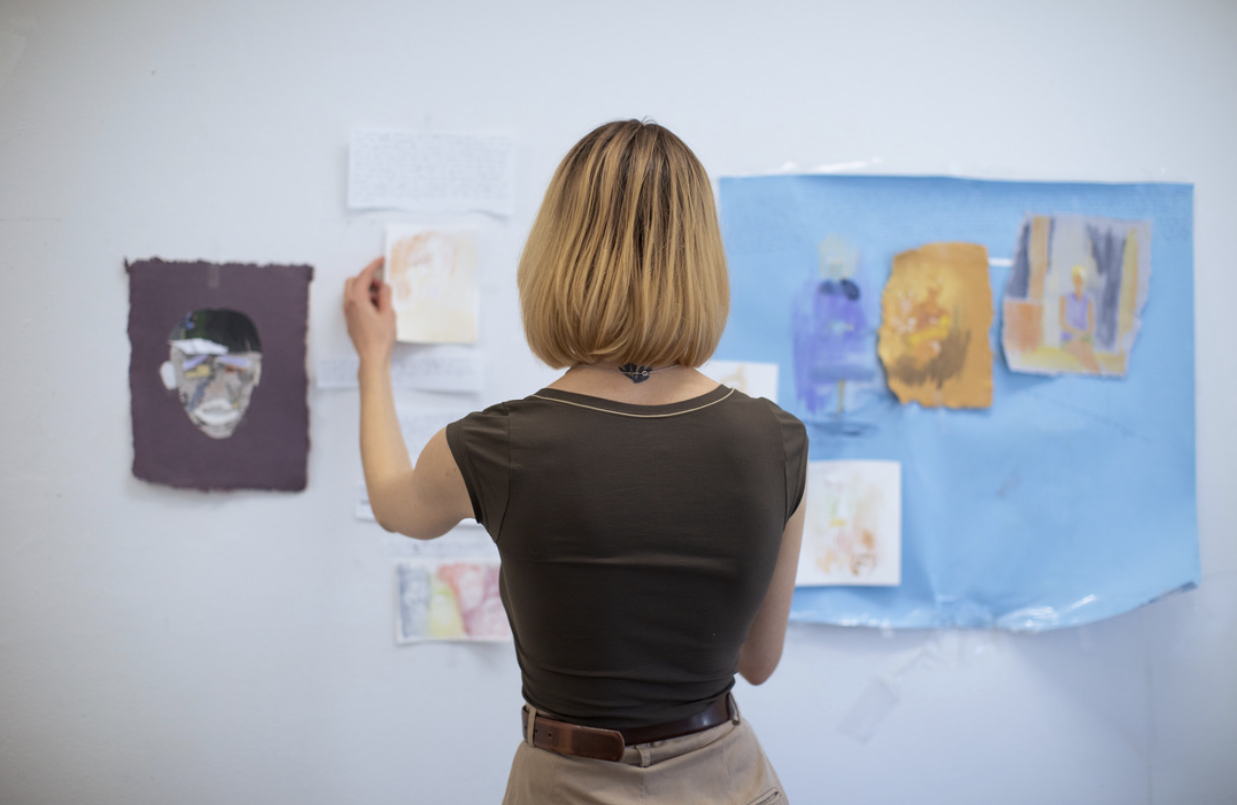
grace (ge) gilbert. photo by Luiza Folegatti, Studios @ Mass MoCA
grace (ge) gilbert is a poet, writer and collage artist. they received their MFA in poetry from the University of Pittsburgh in 2022, where they now teach. they are the author of Holly (YesYes Books, 2026), a hybrid image and text book about the 1976 murder of their paternal grandmother, as well as three chapbooks. their work can be found in 2023's Best of the Net Anthology, the Indiana Review, Iowa Review, Kenyon Review, Ninth Letter, Adroit Journal, and elsewhere. they teach hybrid collage and poetics courses at Brooklyn Poets, Minnesota Center for Book Arts, and other institutions.